A compact Illinois reading view of 20 existing sourced practice explanations. Each card keeps the original question, correct answer and explanation together so that a qualified rule is not detached from its scenario.
A short sample of car driving questions. Read the handbook to cover the other topics you need.
Use this as a review aid after reading the handbook. It is not a state exam aid or a complete list of driving laws. Printing may use several pages; the layout does not shrink the text to promise a single sheet.
At a steady red light, a marked stop line lies before the crosswalk. Where should the front of your car be when you make the required stop?
Correct answer: Behind the stop line
Stop at the marked line. If there is no line, stop before the near crosswalk; if neither exists, stop before entering the intersection.
Source: Illinois Rules of the Road 2026, July 2026 DSD A112.47, Chapter 10 > Traffic Signals > Red Light; p. 77. Current-law check: 625 ILCS 5/11-306(c)(1), reviewed 2026-09-12. Full primary URLs, access status, and retained clauses: illinois-car-rules-2026-09-12.md. · Original question review: 2026-09-12
Review 2 · Completely dark intersection signal
Every lamp facing you at an ordinary traffic-light intersection is dark. This is not a pedestrian hybrid beacon, and no officer is directing traffic. What must you do?
Correct answer: Stop and follow the rules for a stop-sign intersection
An ordinary traffic signal with no illuminated light facing the driver requires a stop. The statute specifically excepts pedestrian hybrid beacons from this dark-signal rule.
Source: Illinois Rules of the Road 2026, July 2026 DSD A112.47, Chapter 10 > Traffic Signals > inoperative signals; p. 77. Current-law check: 625 ILCS 5/11-305(e), reviewed 2026-09-12. Full primary URLs, access status, and retained clauses: illinois-car-rules-2026-09-12.md. · Original question review: 2026-09-12
Review 3 · Turn-signal distance in a business district
You plan a turn in a business district. What is the minimum distance before the turn for a continuous turn signal under Illinois law?
Correct answer: 100 feet
Signal continuously for at least the last 100 feet in a business or residence district. Outside those districts, the minimum is 200 feet; the distinction is location.
Source: Illinois Rules of the Road 2026, July 2026 DSD A112.47, Chapter 4 > Signaling; p. 30. Current-law check: 625 ILCS 5/11-804(b), reviewed 2026-09-12. Full primary URLs, access status, and retained clauses: illinois-car-rules-2026-09-12.md. · Original question review: 2026-09-12
Review 4 · Double solid white lane lines
Two same-direction lanes are separated by double solid white lines. What do those lines tell you?
Correct answer: Do not cross them to change lanes
The Illinois handbook distinguishes a single solid white line, where lane changes are discouraged, from double solid white lines, which prohibit crossing.
Source: Illinois Rules of the Road 2026, July 2026 DSD A112.47, Chapter 10 > Pavement Markings > White Lane Lines; p. 79. Current-law check: 625 ILCS 5/11-305(a); 11-709(d), reviewed 2026-09-12. Full primary URLs, access status, and retained clauses: illinois-car-rules-2026-09-12.md. · Original question review: 2026-09-12
Review 5 · Available lane while passing a bicyclist
You are overtaking a bicyclist. Another same-direction lane is available, and changing into it is safe, practicable, and legal. What must you do?
Correct answer: Change lanes and maintain at least 3 feet of safe passing clearance
Current Illinois law calls for the available, safe, practicable, lawful lane change before overtaking a bicycle. It separately requires a safe passing distance of at least 3 feet, maintained until safely past.
Source: Illinois Rules of the Road 2026, July 2026 DSD A112.47, Chapter 5 > Bicycles > When sharing the road with bicyclists; statutory lane-change duty supplements the handbook's clearance guidance; p. 43. Current-law check: 625 ILCS 5/11-703(d)(1)-(2), reviewed 2026-09-12. Full primary URLs, access status, and retained clauses: illinois-car-rules-2026-09-12.md. · Original question review: 2026-09-12
Review 6 · Parallel-parking distance from the curb
Under the ordinary Illinois parallel-parking rule on a two-way street, what is the maximum permitted distance between your right-hand wheels and the curb?
Correct answer: Within 12 inches
The ordinary Illinois rule on a two-way street is parallel parking with the right-hand wheels within 12 inches of the right curb. Different rules may apply where authorized angle parking is provided.
Source: Illinois Rules of the Road 2026, July 2026 DSD A112.47, Chapter 4 > Parking > Parallel Parking; p. 35. Current-law check: 625 ILCS 5/11-1304(a), reviewed 2026-09-12. Full primary URLs, access status, and retained clauses: illinois-car-rules-2026-09-12.md. · Original question review: 2026-09-12
Review 7 · Opposing bus on an undivided four-lane road
A road has four lanes, with two lanes in each direction and no physical median. A school bus with its red signals operating is stopped in the opposite direction. What does Illinois's opposing-traffic exception provide?
Correct answer: You are not required to stop solely for that opposing bus
The exception covers a highway with at least four lanes permitting at least two lanes of opposing-direction traffic when you meet the bus traveling in the opposite direction. A physical divider is not a requirement; continue cautiously for children and other hazards.
Source: Illinois Rules of the Road 2026, July 2026 DSD A112.47, Chapter 4 > Special Stops > School Buses; p. 32. Current-law check: 625 ILCS 5/11-1414(e), reviewed 2026-09-12. Full primary URLs, access status, and retained clauses: illinois-car-rules-2026-09-12.md. · Original question review: 2026-09-12
Review 8 · Uncontrolled T intersection
Your road ends at a T intersection with another highway. There are no signs, signals, or different controlling rules. What must you do before entering the continuing highway?
Correct answer: Stop, yield to hazardous or already-entering traffic on the continuing highway, then enter when safe
Illinois's specific uncontrolled-T rule requires the driver on the terminating road to stop and yield. The general simultaneous-arrival rule does not cancel this special rule.
Source: Illinois Rules of the Road 2026, July 2026 DSD A112.47, Chapter 4 > Right of Way > T intersections; statute adds the explicit stop duty; p. 26. Current-law check: 625 ILCS 5/11-901.01, reviewed 2026-09-12. Full primary URLs, access status, and retained clauses: illinois-car-rules-2026-09-12.md. · Original question review: 2026-09-12
Review 9 · Speed for conditions
Traffic is flowing at the limit, but visibility and traction have worsened. How should you choose your speed?
Correct answer: Use a slower speed suited to the conditions
A posted limit does not guarantee that speed is safe in the conditions.
Source: Illinois Rules of the Road 2026, July 2026, DSD A112.47; Vehicle Speed; p. 84 · Original question review: 2026-09-12
Review 10 · Hydroplaning prevention
Which adjustment helps reduce hydroplaning risk as water accumulates on the road?
Correct answer: Reduce speed before traction is lost
Lower speed helps tires maintain contact with the road; abrupt control inputs add risk.
Source: Illinois Rules of the Road 2026, July 2026, DSD A112.47; Weather Conditions — Rain; p. 85 · Original question review: 2026-09-12
Review 11 · Entrance lane
What is the purpose of the speed-change lane at an expressway entrance?
Correct answer: To adjust speed and find a safe opening before merging
Signal, observe traffic and use the lane to prepare a safe merge.
Source: Illinois Rules of the Road 2026, July 2026, DSD A112.47; Special Driving Situations and Hazards — Expressway Driving; p. 86 · Original question review: 2026-09-12
Review 12 · Entering a curve
A sharp curve is approaching on a slick road. When is the best time to make the main speed reduction?
Correct answer: Before entering the curve
Slow before the curve and avoid abrupt braking that can upset traction.
Source: Illinois Rules of the Road 2026, July 2026, DSD A112.47; Curves; p. 87 · Original question review: 2026-09-12
Review 13 · Tire blowout
A tire fails suddenly while you are traveling at road speed. What should you prioritize?
Correct answer: Maintain steering control and ease off the accelerator without sudden braking
Keep a firm grip and reduce speed in a controlled way before pulling off safely.
Source: Illinois Rules of the Road 2026, July 2026, DSD A112.47; Equipment Failure — Blowouts; p. 88 · Original question review: 2026-09-12
Review 14 · Being passed
A motorcycle is passing your car. What should you do during the maneuver?
Correct answer: Maintain a steady speed and lane position
A passing motorcyclist needs you to be predictable. Keep your speed steady and stay centered in your lane which lets the motorcyclist complete the maneuver and return to the lane cleanly.
Source: Illinois Rules of the Road 2026, July 2026, DSD A112.47; Motorcycles — Passing; p. 41 · Original question review: 2026-09-12
Review 15 · Farm entrances
You are following a tractor past fields with unmarked access points. What movement should you anticipate?
Correct answer: A wide turn into an entrance that is not obvious from behind
Slow-moving equipment may turn into unmarked entrances; leave room and pass only when safe.
Source: Illinois Rules of the Road 2026, July 2026, DSD A112.47; Slow-Moving Vehicles — Turns and Passing; p. 46 · Original question review: 2026-09-12
Review 16 · Regulatory signs
At this red sign, what action is required even if no other traffic is visible?
FHWA MUTCD / Standard Highway Signs — source and adaptations in /signs/LICENSES.md
Correct answer: Come to a complete stop, then proceed when safe
This sign requires a full stop. Where present, stop at the stop line before proceeding when safe.
Source: Illinois Rules of the Road 2026 (July 2026, DSD A 112.47), Chapter 9 > Stop; p. 65 · Original question review: 2026-09-12
Review 17 · Warning signs
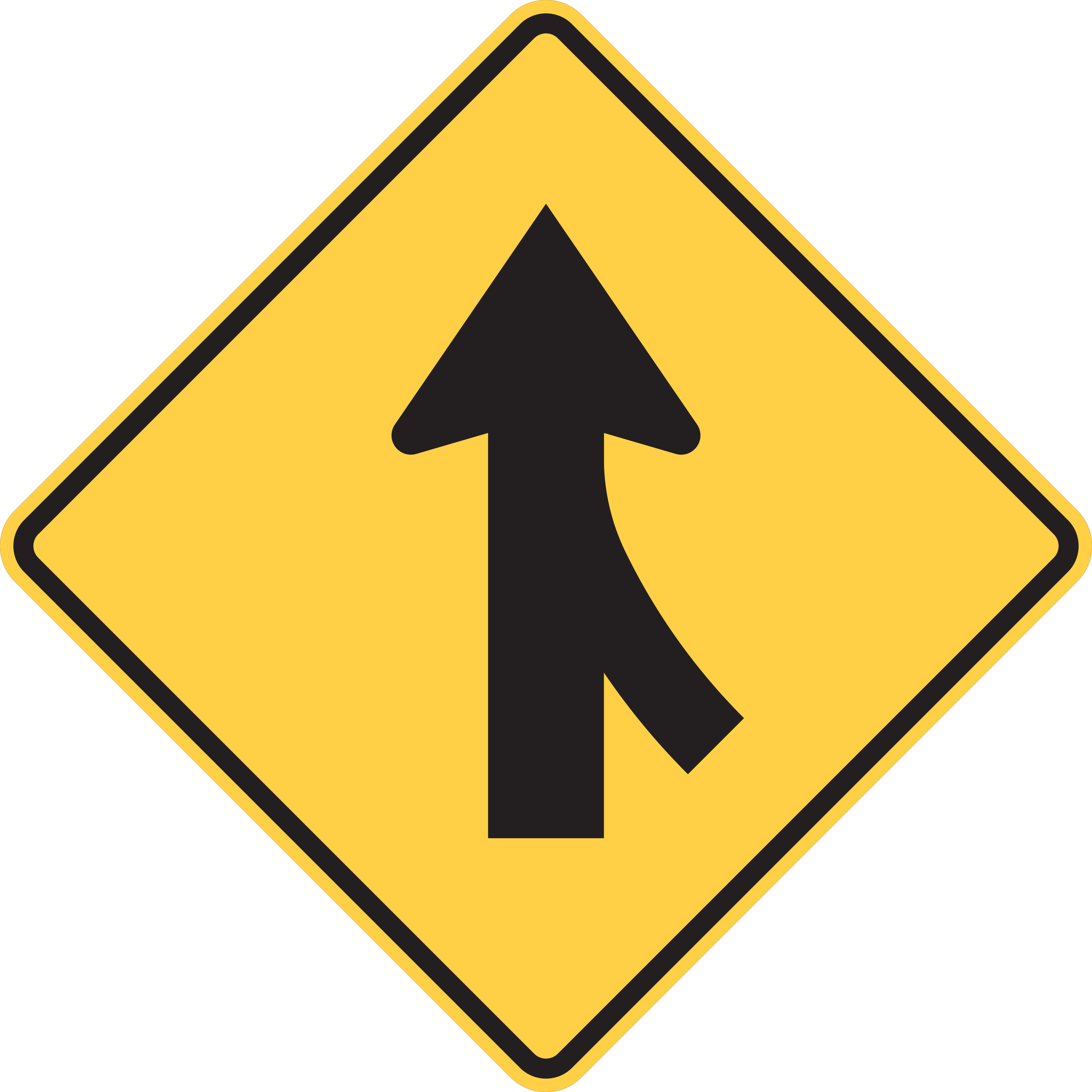
What approaching traffic pattern is represented by this warning symbol?
FHWA MUTCD / Standard Highway Signs — source and adaptations in /signs/LICENSES.md
Correct answer: Traffic will join the roadway from the right
The symbol shows traffic joining from the right. Watch for the merging movement and adjust speed and position safely.
Source: Illinois Rules of the Road 2026 (July 2026, DSD A 112.47), Chapter 9 > Merging Lanes; p. 72 · Original question review: 2026-09-12
Review 18 · Warning signs
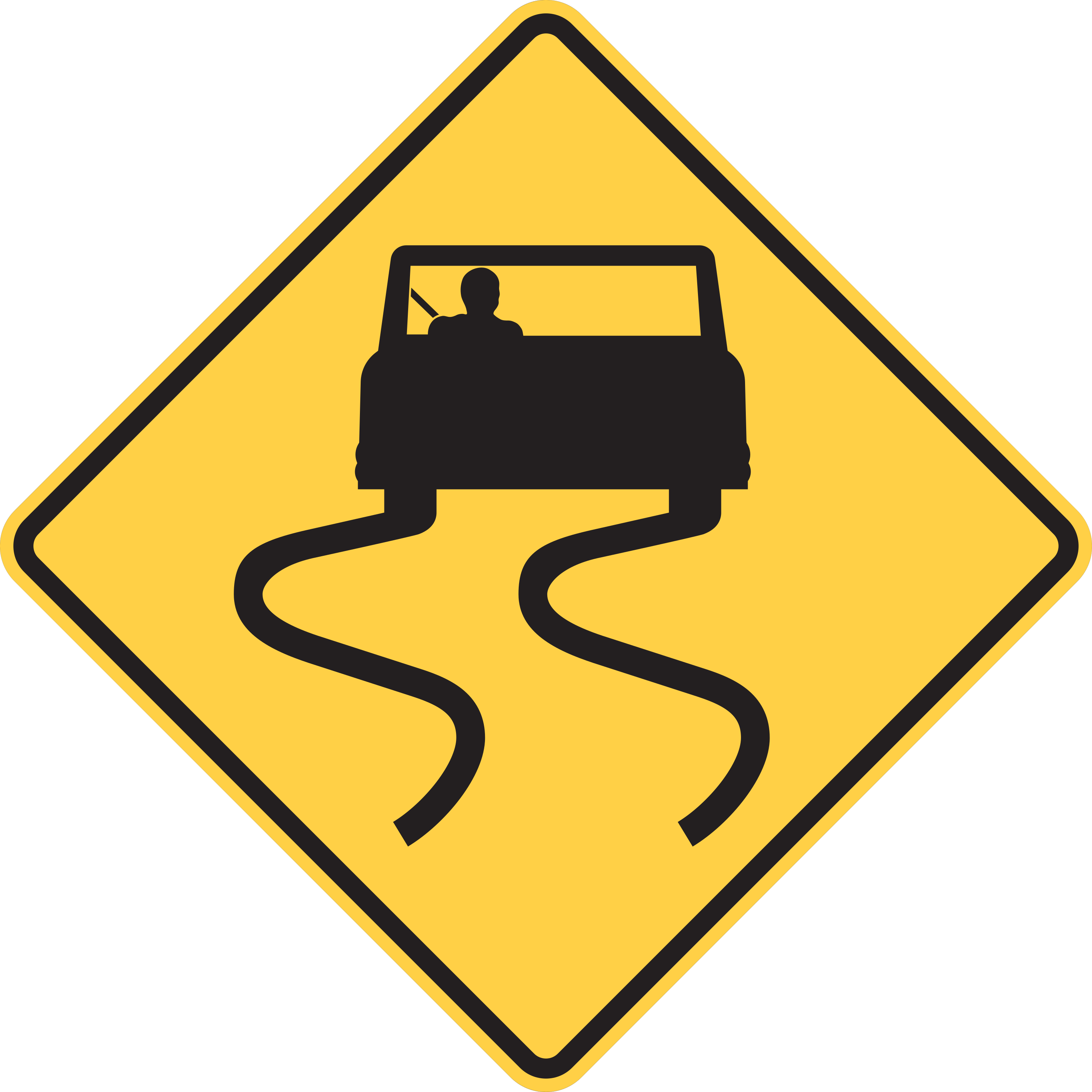
What pavement hazard is represented by the car-and-curved-tracks symbol?
FHWA MUTCD / Standard Highway Signs — source and adaptations in /signs/LICENSES.md
Correct answer: The road can become unusually slippery when wet
The symbol warns that wet pavement can cause loss of control. Slow down and allow for a longer stop.
Source: Illinois Rules of the Road 2026 (July 2026, DSD A 112.47), Chapter 9 > Slippery Pavement; p. 70 · Original question review: 2026-09-12
Review 19 · Minor consent when a parent cannot attend
A 17-year-old who needs parental consent is applying for an Illinois license, but the parent cannot come along to the Secretary of State facility. What can the parent provide instead?
Correct answer: A completed and notarized Affidavit/Consent for Minor to Drive.
The GDL service allows the parent or legal guardian to accompany the teen and provide written consent, or to complete and notarize the specified affidavit. Informal messages do not replace that process.
An applicant plans to use a relative's car for the Illinois driving exam. Besides meeting the vehicle's other requirements, what must the applicant provide?
Correct answer: Proof that the vehicle has the required insurance.
The test vehicle must be properly insured, and proof of insurance must be provided for the driving exam. Borrowing the vehicle does not remove this requirement.
Source: 2026 Illinois Rules of the Road, p. 14: Driving Exam, test-vehicle insurance bullet; current license service, Renewal Requirements, proof-of-liability-insurance bullet. · Original question review: 2026-09-12