A compact Michigan reading view of 20 existing sourced practice explanations. Each card keeps the original question, correct answer and explanation together so that a qualified rule is not detached from its scenario.
A short sample of car driving questions. Read the handbook to cover the other topics you need.
Use this as a review aid after reading the handbook. It is not a state exam aid or a complete list of driving laws. Printing may use several pages; the layout does not shrink the text to promise a single sheet.
You can also use your browser’s Print menu. Review the preview for your paper size before saving.
Test-format qualifications
Adult operator and signs knowledge examination (18+): The question count is not confirmed in the reviewed agency sources. The correct-answer threshold is not confirmed.
Both the Operator and Signs sections must be passed.
Source qualifications for this format
The agency describes approximately 45 minutes for Operator and 15 minutes for Signs; these are not published hard time limits.
Online and office versions are described as the same examination.
The reviewed adult page does not publish section counts or passing percentages; do not assume the frequently repeated 50/40 configuration.
English and other written/audio languages are mentioned, but no complete list was verified.
Teen Segment 1 driver-education knowledge examination: The question count is not confirmed in the reviewed agency sources. Agency passing statement: 70% or higher.
Source qualifications for this format
Age range means Segment 1 enrollment from 14 years 8 months until the eighteenth birthday, not permit issuance.
Level 1 learner licensing begins at 14 years 9 months.
Do not apply the Segment 1 threshold to the adult operator exam. The page also describes a distinct Segment 2 examination.
You stop at a red light on a two-way street. The one-way road to your left carries traffic leftward. No device prohibits the turn. What may you do?
Correct answer: Turn left after yielding as required
Michigan permits a stopped left turn from a one-way or two-way street into a one-way road carrying traffic in the turn's direction, unless a traffic-control device prohibits it. Required yielding still applies.
All lights at an intersection are out. No officer, temporary sign or other device directs traffic. What should you do?
Correct answer: Stop, yield to hazards, and proceed with care
With no other direction, stop at the marked line, or before the near crosswalk if no line exists, or before the intersection if neither exists. Yield to immediate hazards and use ordinary care.
You are stopped behind a school bus whose alternating red lights are on. Which event ends this particular requirement to remain stopped?
Correct answer: The bus resumes moving or its visual signal stops
The bus stop requirement continues until the bus resumes motion or its visual signals are no longer actuated. A guessed time or a wave from another driver does not end it.
A car develops persistent tire vibration and repeatedly loses pressure. What is the appropriate next step?
Correct answer: Have a tire-service professional inspect it
Repeated air loss and steady vibration point to damage such as a puncture, bent rim or broken belt. Have a tire shop inspect it before the problem turns into a blowout.
Review 12 · Vehicle condition after an animal collision
Your car still starts after hitting a deer. What should you conclude about continuing the trip?
Correct answer: Check for damage before continuing
A deer strike can crack lights, puncture the radiator or bend steering parts even when the engine runs. Walk around the car, look for leaks and broken lights, and call a tow if anything is unsafe.
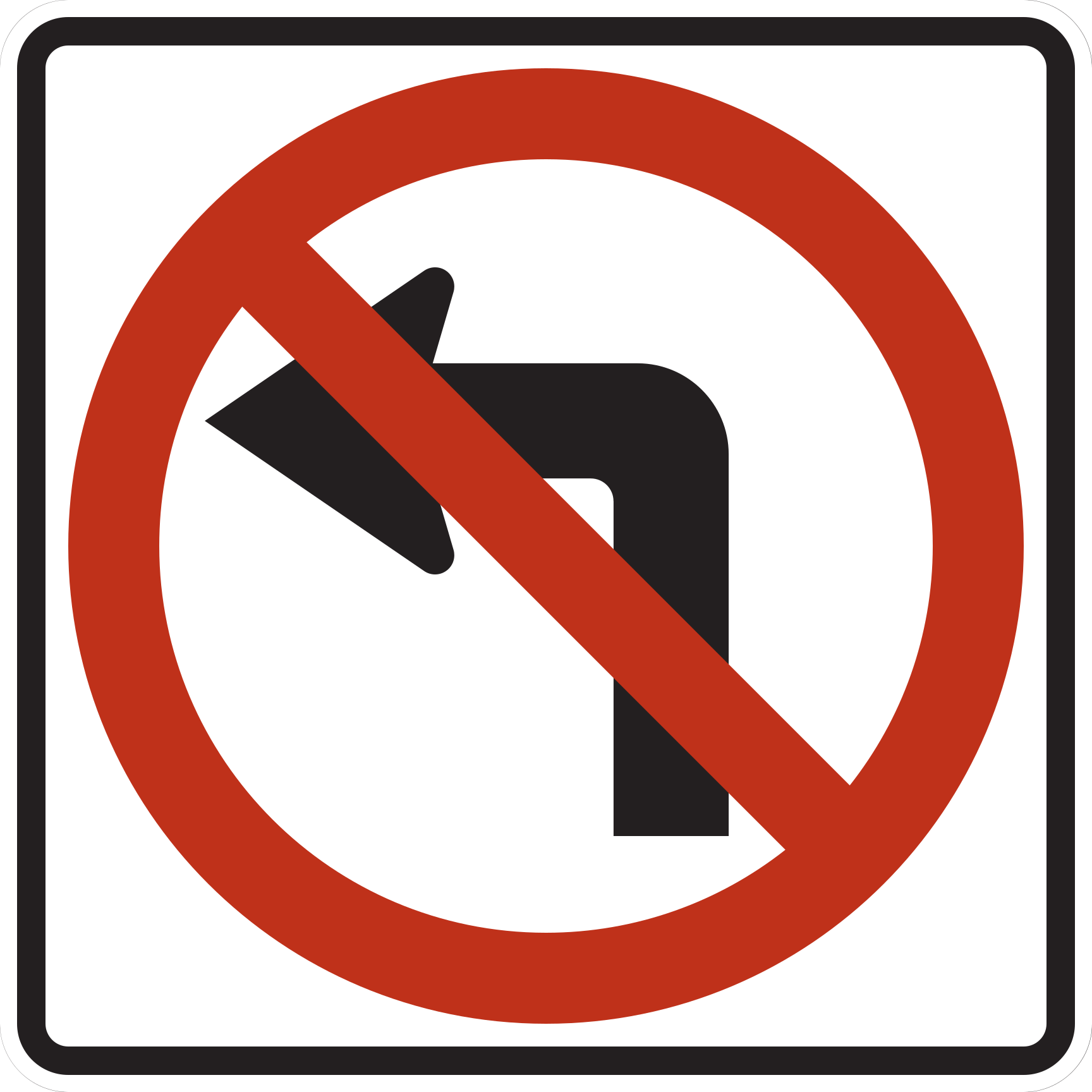
Your route calls for a left turn at an intersection displaying this sign. What does the sign tell you?
FHWA MUTCD / Standard Highway Signs — source and adaptations in /signs/LICENSES.md
Correct answer: Do not make the planned left turn
NO LEFT TURN prohibits the left-turn movement. Stopping, yielding, or choosing a different lane does not remove the displayed restriction.
Source: FHWA MUTCD, 11th Edition with Revision 1 (December 2025), Section 2B.26, paragraphs 01–03, R3-2; p. 89 · Original question review: 2026-09-12
Review 14 · Warning signs
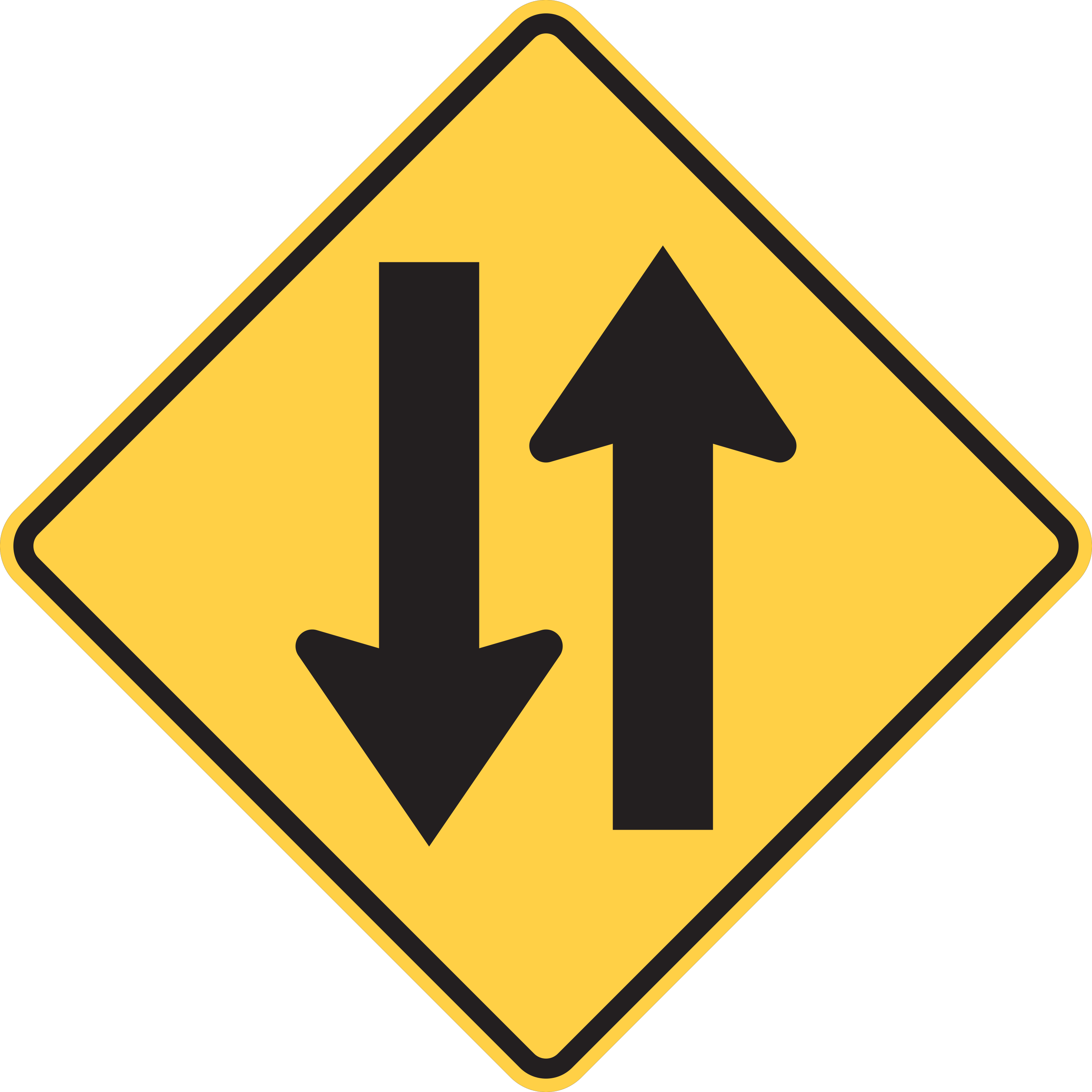
How should you interpret the two arrows pointing in opposite directions?
FHWA MUTCD / Standard Highway Signs — source and adaptations in /signs/LICENSES.md
Correct answer: Traffic travels in both directions
TWO-WAY TRAFFIC warns that vehicles travel in opposite directions. It is not an added-lane sign or an instruction to choose an exit.
Source: FHWA MUTCD, 11th Edition with Revision 1 (December 2025), Section 2C.51, paragraphs 01–03, W6-3; p. 189 · Original question review: 2026-09-12
Review 15 · Warning signs
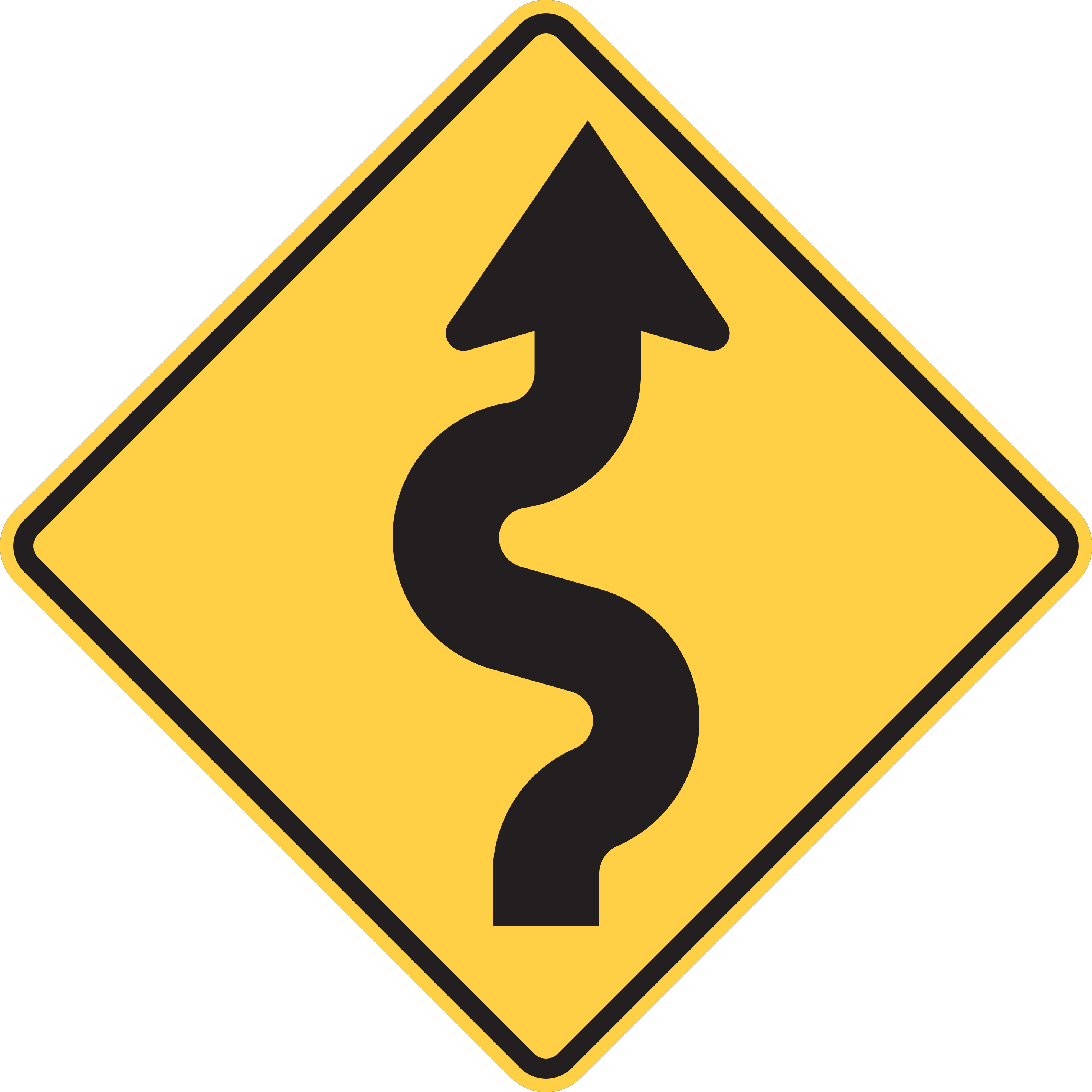
Which road alignment best matches the repeated bends in this arrow?
FHWA MUTCD / Standard Highway Signs — source and adaptations in /signs/LICENSES.md
Correct answer: A series of closely spaced curves
WINDING ROAD warns of a series of changes in roadway direction. It conveys neither an exact speed nor a distance unless a separate plaque supplies that information.
Source: FHWA MUTCD, 11th Edition with Revision 1 (December 2025), Section 2C.07, paragraphs 05–06, W1-5; p. 155 · Original question review: 2026-09-12
Review 16 · Holding a phone with a shoulder
A fully licensed adult wedges a phone between the shoulder and ear during a routine call while driving. Both hands remain on the wheel. Does this satisfy Michigan's hands-free rule?
Correct answer: No. Supporting the phone with a shoulder still counts.
The rule includes supporting a phone with a hand, arm, or shoulder. A routine call does not become hands-free just because neither hand is holding the device.
A person is injured in a crash involving your car and needs medical help. Beyond exchanging the required information, what responsibility does Michigan impose?
Correct answer: Give reasonable help in securing medical aid or transport.
Michigan requires reasonable assistance to an injured person in obtaining medical aid or arranging or providing transportation. Calling emergency services can help secure aid; this is not an instruction to perform untrained treatment or move an injured person regardless of the circumstances.
Review 18 · Impaired driving in a public parking lot
After drinking, a person's ability to drive is visibly impaired. The person plans to move a car across a shopping-center lot open to the public without entering a street. Does Michigan's impaired-driving rule apply?
Correct answer: Yes. The rule also covers public-access parking areas.
Michigan's visibly impaired driving prohibition is not limited to streets and highways. It also covers places open to the public or generally accessible to motor vehicles, expressly including parking areas.
Who administers the ordinary Michigan driving skills test?
Correct answer: An authorized independent driver testing business
Michigan uses independent testing organizations with state-authorized examiners. Teaching or repairing vehicles alone does not confer testing authority.