A compact New York reading view of 20 existing sourced practice explanations. Each card keeps the original question, correct answer and explanation together so that a qualified rule is not detached from its scenario.
A short sample of car driving questions. Read the handbook to cover the other topics you need.
Use this as a review aid after reading the handbook. It is not a state exam aid or a complete list of driving laws. Printing may use several pages; the layout does not shrink the text to promise a single sheet.
You can also use your browser’s Print menu. Review the preview for your paper size before saving.
Test-format qualifications
Class D / DJ: 20 questions. 14 correct are needed to pass, subject to the separate requirements below.
At least 2 of the 4 road-sign questions must be correct, even when your total is 14 or more.
Source qualifications for this format
The manual confirms 14 of 20 plus two of four signs; it does not publish a separate passing percentage. Six total errors is arithmetic from 20 minus 14, and does not replace the sign-section requirement. Class D exams are available in multiple languages; a complete current list and time limit were not confirmed. School OKTA English/Spanish availability is not a statewide language list.
Retained facts checked 2026-10-12.
New York Driver's Manual, Chapter 1: knowledge-test requirements
Source-linked explanations to review
Review 1 · Failed traffic signals
All signal lamps at an intersection are dark, and no officer is directing traffic. How should you approach it?
Correct answer: Stop as at a stop sign, then apply right-of-way rules
A failed signal does not give either road automatic priority. Stop in the required position, then proceed only when the right-of-way rules and traffic conditions allow.
You intend to go straight on green, but the traffic queue beyond the junction leaves no room for your car to clear it. What is the appropriate action?
Correct answer: Wait before the intersection until there is room beyond it
New York prohibits rolling into a junction when the queue beyond it has no space for your vehicle. If you stop in the middle when the light changes, you block cross traffic and pedestrians.
Source: NY DMV Chapter 5 > Right-of-Way, backed-up traffic and blocking the intersection · Original question review: 2026-09-12
Review 4 · Siren whose location is unclear
You hear a nearby siren on a two-way road but cannot yet determine where the emergency vehicle is coming from. What should you do?
Correct answer: Safely pull to the right and stop until you know it is not approaching you
When a nearby siren's source is uncertain, the manual directs you to move safely to the right edge and stop until you can determine that it is not heading toward you.
Source: NY DMV Chapter 5 > Emergency Vehicles, siren or air-horn heard nearby but location unknown · Original question review: 2026-09-12
Review 5 · Rear-wheel path in a turn
You are turning right close to a curb. Why must you allow for the path of your rear wheels, even after the front wheels have cleared an obstacle?
Correct answer: The rear wheels track inside the front-wheel path, nearer the curb
The rear wheels travel inside the front-wheel path during a turn. Front-wheel clearance alone does not ensure that the back of the vehicle will clear the curb or another obstacle.
Source: NY DMV Chapter 5 > Turns, rear wheels travel inside the path of the front wheels · Original question review: 2026-09-12
Review 6 · Oncoming clearance during a pass
A lawful pass would take you into an opposing lane. You cannot return to your authorized lane before coming within 200 feet of an approaching vehicle. What should you do?
Correct answer: Do not begin that pass
When passing in an opposing lane, you must return before coming within 200 feet of an approaching vehicle, as well as avoid interfering with traffic. Do not rely on others to make room.
A school bus across the median of a divided New York highway has stopped with its red warning lights flashing. You are approaching in the opposite direction. What must you do?
Correct answer: Stop before reaching the bus despite the divided roadway
New York requires approaching traffic from both directions to stop for the school bus's flashing red signal, including on opposite sides of a divided highway.
Source: NY DMV Chapter 6 > School Buses, opposite side of a divided highway; VTL §1174(a) · Original question review: 2026-09-12
Review 8 · Loading at a No Parking location
A curb has a NO PARKING restriction but no stricter stopping or standing restriction. Which use fits the ordinary New York exception?
Correct answer: A temporary stop while actively loading merchandise into the car
A parking prohibition allows temporary stopping or standing while actually loading or unloading merchandise or passengers. Merely remaining in the vehicle or running the engine is not active loading.
You will leave your car parked near a railroad crossing, not load or unload it. No control sets another distance. From what point is the 50-foot restriction measured?
Correct answer: The nearest rail of the crossing
The parking restriction extends 50 feet from the nearest rail, not from a warning sign or the center of the crossing. Published controls may indicate a different distance.
You are on a New York rural highway with no posted limit, no special speed limit established for that road, and no condition requiring slower travel. What is the general maximum?
Correct answer: 55 mph.
The general state maximum is 55 mph unless another authorized limit or a hazard requires otherwise.
A hands-free conversation becomes emotionally intense even though both hands remain on the wheel. What is the safety concern?
Correct answer: The conversation can take your attention away from driving.
A heated phone call pulls your thoughts away from the road even with both hands on the wheel. If the talk becomes upsetting, end the call or pull over before continuing.
Source: Chapter 8 > Driver Distractions: mental activities and emotional conversations. · Original question review: 2026-09-12
Review 12 · Trip planning
You are planning a long drive after a week of short nights. Which preparation best reduces fatigue risk?
Correct answer: Get adequate sleep beforehand and allow time for rest stops.
Several short nights in a row build a sleep debt that one cup of coffee cannot pay off. Sleep fully before you set out and plan a stop about every two hours.
On an unlit road, your headlights reveal only a limited stretch ahead. How should you choose your speed?
Correct answer: Keep it low enough to stop within the distance you can see.
Your headlights show only so much road. Pick a speed at which you can stop before the edge of the lit area; otherwise anything that appears there will be too close to avoid.
Source: Chapter 10 > Night Driving: stop within the distance headlights illuminate. · Original question review: 2026-09-12
Review 16 · Winter driving
The weather has dropped below freezing, but the ordinary pavement appears mostly clear. Where should you be especially alert for early ice?
Correct answer: Bridges, ramps and overpasses.
Cold air surrounds a bridge deck on top and underneath, so it freezes sooner than ground-level pavement. Slow before you get on one and avoid sudden braking or steering while crossing.
Source: Chapter 10 > How to Drive in Winter: bridges, ramps and overpasses freeze first. · Original question review: 2026-09-12
Review 17 · Passing bicycles
On a New York road, you are overtaking a bicycle traveling in your direction. What passing clearance does the statewide rule require?
Correct answer: Pass on the left at a safe distance and remain clear until safely past.
VTL 1122-a requires a safe passing distance; it does not give a universal three-foot measurement.
As you approach your chosen exit while driving through a roundabout, what should you do?
Correct answer: Signal right before exiting and yield to pedestrians at the exit crossing.
Use the right signal as you approach your exit, then leave carefully and yield to crossing pedestrians.
Source: Chapter 8 > Roundabouts > Exiting the Roundabout: right signal before exit and yielding to pedestrians. · Original question review: 2026-09-12
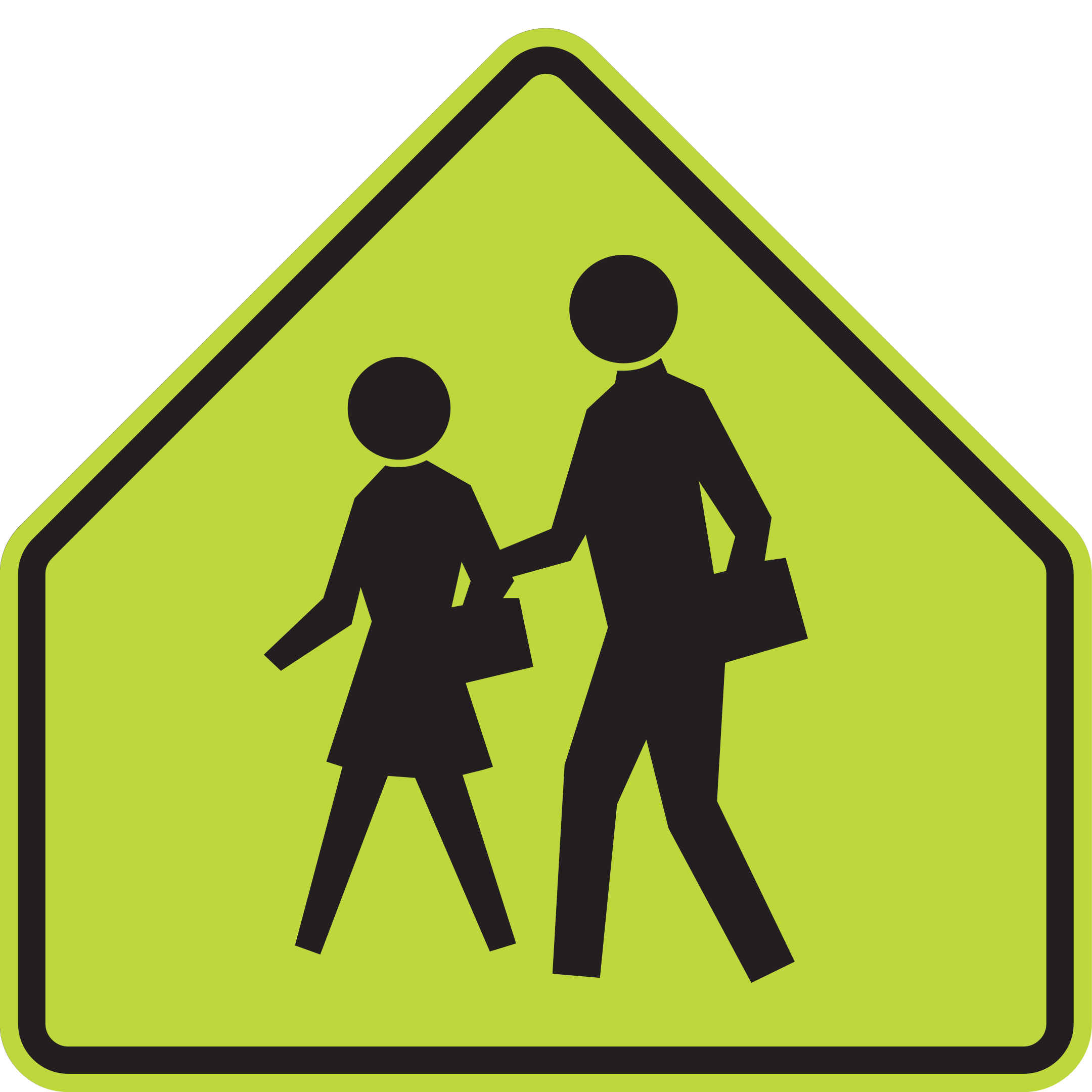
Review 19 · School crossing
What kind of area should this five-sided sign prompt you to watch for?
FHWA MUTCD / Standard Highway Signs — source and adaptations in /signs/LICENSES.md
Correct answer: A school area or school crossing
The two figures on a five-sided sign warn of a school area or school crossing. Watch for children and obey crossing instructions and any separate speed signs.
Source: NY DMV Road Signs You Must Know > School crossing · Original question review: 2026-09-12
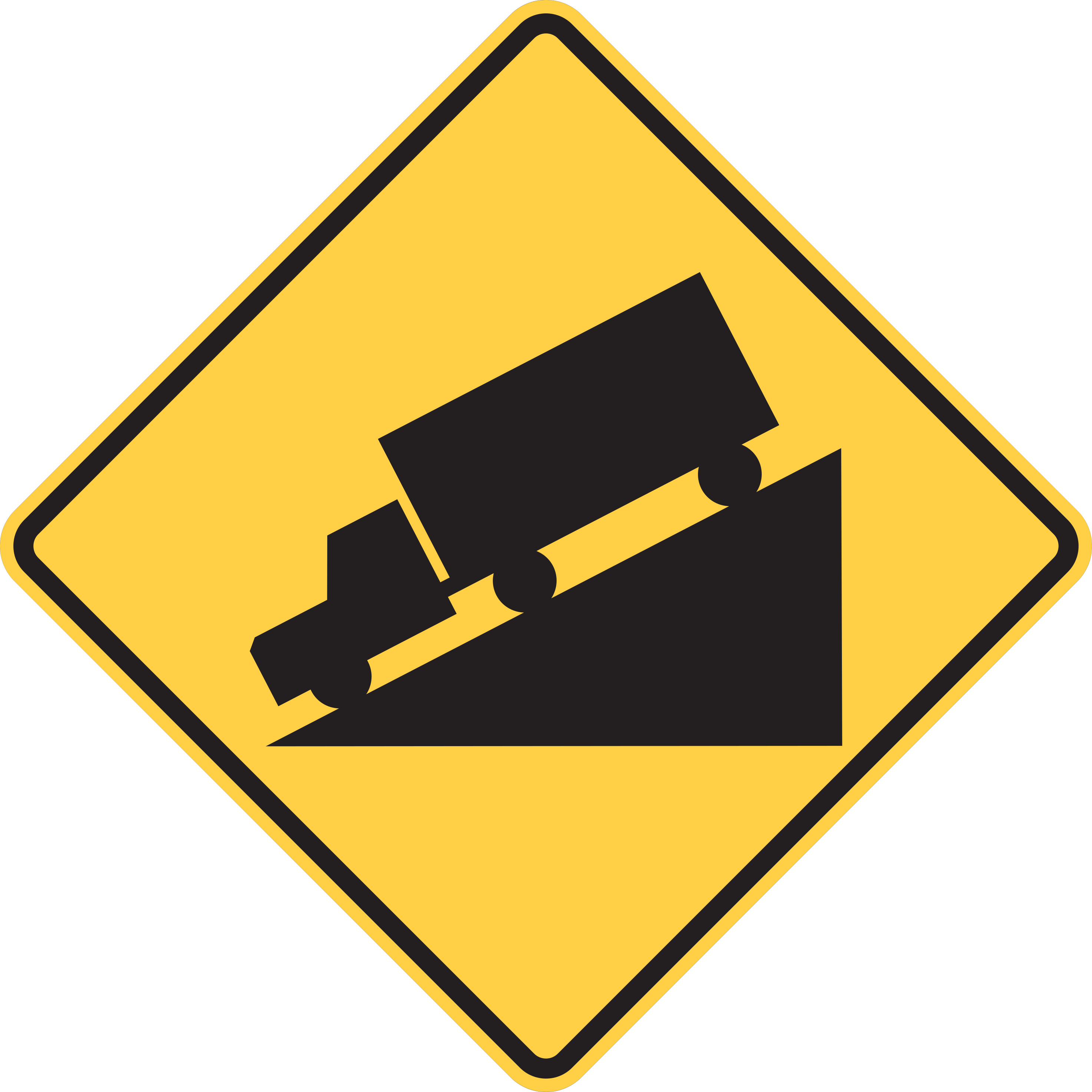
Review 20 · Hill ahead
What is this sign, with a truck pictured on an incline, warning of?
FHWA MUTCD / Standard Highway Signs — source and adaptations in /signs/LICENSES.md
Correct answer: A steep downgrade ahead
The symbol warns of a steep grade. Check your speed and choose a lower gear before the descent so you do not depend only on the brakes. Cars use the road too; it is not a truck route.
Source: NY DMV Road Signs You Must Know > Hill ahead · Original question review: 2026-09-12