What shape is the sign shown?
Correct answer: Octagon
The eight-sided octagon is reserved for STOP signs.
Source: Section 7 — Signs: STOP; YIELD; shapes; prohibitions ↗
How should you respond when approaching this sign?
Correct answer: Slow down and give the right-of-way when needed
A YIELD sign gives priority to road users who would conflict with your path. Reduce speed, check for vehicles, bicyclists, and pedestrians, and stop if needed. Traffic behind you does not remove your duty to yield.
Source: Section 7 — Signs: Red YIELD Sign ↗
What kind of information does this sign communicate?
Correct answer: A hazard or road condition ahead
Diamond-shaped yellow signs warn of conditions or hazards ahead.
Source: Section 7 — Signs: STOP; YIELD; shapes; prohibitions ↗
What does this sign identify?
Correct answer: A school area or school crossing
The pentagon shape is used for school areas and school crossings.
Source: Section 7 — Signs: STOP; YIELD; shapes; prohibitions ↗
What does this sign warn you about?
Correct answer: A railroad crossing ahead
The circular railroad advance-warning sign tells you to slow, look, listen, and prepare to stop.
Source: Section 7 — Signs: STOP; YIELD; shapes; prohibitions ↗
What does the red circle and slash on this sign indicate?
Correct answer: The action is prohibited
The symbol inside shows an action that is not allowed.
Source: Section 7 — Signs: STOP; YIELD; shapes; prohibitions ↗
What does this sign tell an approaching driver?
Correct answer: Do not enter this road or ramp
The sign prohibits entry from the direction where it is posted.
Source: Section 7 — Signs: STOP; YIELD; shapes; prohibitions ↗
What does this sign tell you about your direction of travel?
Correct answer: You are traveling against the legal direction of traffic
A WRONG WAY sign faces traffic that has entered or is moving against the permitted direction.
Source: Section 7 — Signs: STOP; YIELD; shapes; prohibitions ↗
What does this pavement marking indicate?
Correct answer: Where approaching traffic must yield or stop when required
A yield line marks where approaching vehicles should yield or stop when necessary; the triangles point toward approaching traffic.
Source: MUTCD 2009 Section 3B.16 — Yield lines; Figure 3B-16 ↗
Which movement does this sign restrict?
Correct answer: The indicated turn is prohibited
A red circle and slash over a movement symbol prohibits that movement.
Source: Section 7 — Signs: STOP; YIELD; shapes; prohibitions ↗
What does the number on this sign represent?
Correct answer: The maximum lawful speed under normal conditions
A posted SPEED LIMIT sign states the maximum lawful speed; California’s Basic Speed Law can require a lower speed when conditions are unsafe.
Source: Section 8 — Manage Your Speed: Basic Speed Law ↗
What kind of message does this sign communicate?
Correct answer: A rule or regulation
White rectangular signs commonly state rules drivers must obey.
Source: Section 7 — Signs: STOP; YIELD; shapes; prohibitions ↗
What should you expect beyond this sign?
Correct answer: Road workers or maintenance activity
The worker-with-shovel symbol warns of workers ahead. Adjust speed for conditions and watch for people and equipment.
Source: MUTCD 2009 Section 6F.33 — Workers (W21-1) ↗
What information does this sign provide?
Correct answer: Directions, routes, and destinations
Green guide signs help with routes, distances, exits, and destinations.
Source: MUTCD 2009 Section 2A.10 — Common uses of sign colors ↗
What does this sign help drivers locate?
Correct answer: Motorist services
Blue signs often point to services such as fuel, food, lodging, or medical help.
Source: MUTCD 2009 Figure 2I-1 — General service signs ↗
What kind of destination does this sign identify?
Correct answer: Recreational or cultural destinations
Brown guide signs are used for parks, recreation, and cultural-interest locations.
Source: MUTCD 2009 Figure 2M-2 — Recreation and cultural guide signs ↗
What change in the road does this sign warn about?
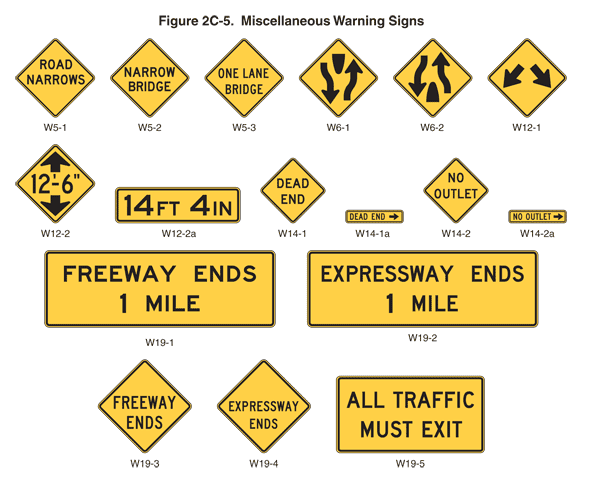
Correct answer: A divided roadway begins ahead
A divided roadway is ahead. On the similar divided-highway-ends sign, the median symbol is at the bottom instead.
Source: MUTCD 2009 Figure 2C-5 — W6-1 divided highway; W6-2 divided highway ends ↗
What should you anticipate when you see this sign?
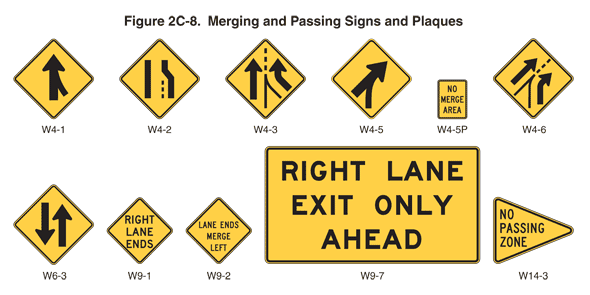
Correct answer: Traffic entering your lane area
Watch for traffic joining the roadway and adjust speed or space when safe.
Source: MUTCD 2009 Figure 2C-8 — W4-1 merging traffic ↗
How should you drive in wet conditions after seeing this sign?
Correct answer: Reduce speed and avoid sudden maneuvers
Wet pavement may reduce traction, so slow down and steer or brake smoothly.
Source: Section 8 — Slippery Roads: reduce speed and avoid sudden maneuvers ↗
What should you be prepared for beyond this sign?
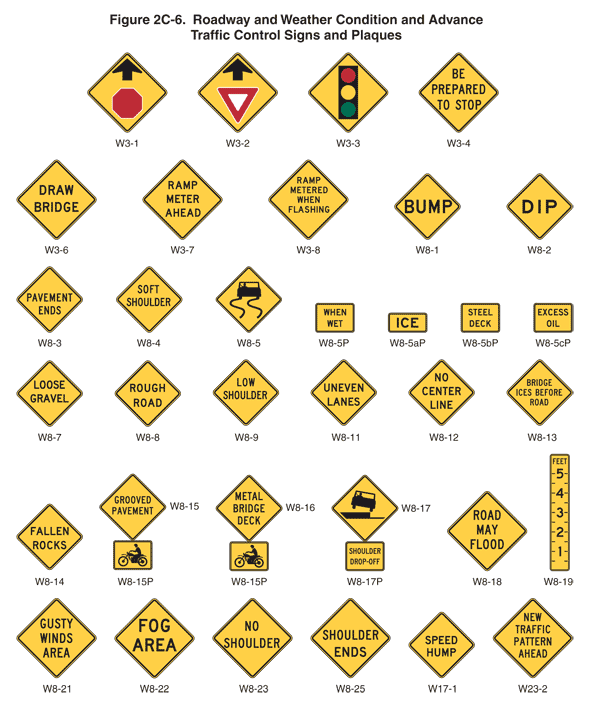
Correct answer: Expect a signal and be ready to stop
The warning gives you time to notice the upcoming signal and adjust safely.
Source: MUTCD 2009 Figure 2C-6 — W3-3 signal ahead ↗
What change in available road width should you expect?
Correct answer: A narrower roadway ahead
This warning concerns the width of the road ahead, not vehicle height or a complete closure.
Source: FHWA MUTCD 2009 Figure 2C-5 — W5-1 Road narrows ↗
What should you anticipate at the bridge ahead?
Correct answer: A bridge with a narrower roadway
NARROW BRIDGE warns about the roadway width at the bridge. It is different from a drawbridge or clearance warning.
Source: FHWA MUTCD 2009 Figure 2C-5 — W5-2 Narrow bridge ↗
What does this sign tell you about the bridge?
Correct answer: Its roadway has only one lane
The warning identifies a bridge with only one lane. It does not by itself turn the entire road into a one-way street or grant you priority over approaching traffic.
Source: FHWA MUTCD 2009 Figure 2C-5 — W5-3 One lane bridge ↗
What vehicle dimension should you check after seeing this sign?
Correct answer: Vertical clearance
Opposing vertical arrows and a height identify a clearance warning. The number on this example is not the clearance of every bridge or overhead obstruction.
Source: FHWA MUTCD 2009 Figure 2C-5 — W12-2 Low clearance ↗
What does this sign tell you about continuing along this road?
Correct answer: The road ends rather than continuing through
DEAD END identifies a road that terminates. It is not a sign directing traffic to a new through route.
Source: FHWA MUTCD 2009 Figure 2C-5 — W14-1 Dead end ↗
What does this NO OUTLET sign mean?
Correct answer: The roads ahead do not provide a through route to another exit
NO OUTLET warns that the road network ahead does not lead through to another exit. It is not the same instruction as DO NOT ENTER.
Source: FHWA MUTCD 2009 Figure 2C-5 — W14-2 No outlet ↗
What road classification change is approaching?
Correct answer: The freeway ends one mile ahead
Read both the road-status message and the distance. The one-mile wording is an example of an advance warning, not a universal distance.
Source: FHWA MUTCD 2009 Figure 2C-5 — W19-1 Freeway ends ahead ↗
What must traffic on this roadway prepare to do?
Correct answer: Prepare to leave the roadway using the indicated exit route
The message applies to all traffic, rather than only vehicles already in an optional exit lane. Follow the posted route rather than assuming a through route remains available.
Source: FHWA MUTCD 2009 Figure 2C-5 — W19-5 All traffic must exit ↗
What does this warning sign tell you?
Correct answer: A stop sign is ahead
The yellow diamond provides advance warning. The red octagonal sign at the stopping location is the regulatory STOP sign.
Source: FHWA MUTCD 2009 Figure 2C-6 — W3-1 Stop ahead ↗
What should you prepare to encounter at the next junction?
Correct answer: A yield sign is ahead
The arrow and yield symbol are an advance warning of a yield sign. They do not grant the approaching driver right-of-way.
Source: FHWA MUTCD 2009 Figure 2C-6 — W3-2 Yield ahead ↗
What surface feature is ahead?
Correct answer: A raised irregularity in the road
A bump is a raised surface irregularity. Compare it with DIP, which identifies a depression.
Source: FHWA MUTCD 2009 Figure 2C-6 — W8-1 Bump ↗
How does the road surface change here?
Correct answer: A depression in the road surface
DIP warns of a low depression in the roadway rather than a raised bump or a change in lane count.
Source: FHWA MUTCD 2009 Figure 2C-6 — W8-2 Dip ↗
What change in road surfacing should you expect?
Correct answer: A transition away from a paved surface
The message concerns the road surface. Do not confuse the end of pavement with a DEAD END warning.
Source: FHWA MUTCD 2009 Figure 2C-6 — W8-3 Pavement ends ↗
Which part of the roadway may not support your vehicle normally?
Correct answer: The shoulder beside the travel lane
The warning applies to the shoulder surface beside the traveled roadway. It is not an invitation to use that area as an extra lane.
Source: FHWA MUTCD 2009 Figure 2C-6 — W8-4 Soft shoulder ↗
What difference between neighboring lane surfaces should you expect?
Correct answer: Adjacent lane surfaces at different levels
The warning refers to a difference in lane-surface elevation, not a difference in speed limits or who may use each lane.
Source: FHWA MUTCD 2009 Figure 2C-6 — W8-11 Uneven lanes ↗
What does this sign mean?
Correct answer: The road has no centerline marking
An absent centerline is the condition being warned about. It does not establish one-way operation or unrestricted passing permission.
Source: FHWA MUTCD 2009 Figure 2C-6 — W8-12 No center line ↗
What should you be alert for at the edge of the pavement?
Correct answer: A lower shoulder next to the pavement edge
The symbol and plaque warn of an elevation drop at the shoulder, rather than a required lane maneuver.
Source: FHWA MUTCD 2009 Figure 2C-6 — W8-17 Shoulder drop-off ↗
Which assumption should you avoid after seeing this sign?
Correct answer: That the old lane arrangement still applies
The warning alerts familiar drivers as well as new visitors to a changed arrangement ahead. Pay attention to current signs and markings instead of relying on memory.
Source: FHWA MUTCD 2009 Figure 2C-6 — W23-2 New traffic pattern ↗
What lane change should you anticipate ahead?
Correct answer: One lane ends instead of continuing separately
The taper shows a lane ending. On the added-lane symbol, the incoming path continues as a separate lane alongside the through lane.
Source: FHWA MUTCD 2009 Figure 2C-8 — W4-2 Lane ends ↗
How will traffic from the joining road enter?
Correct answer: Entering traffic has an added lane
The separate continuing paths distinguish an added lane from the merging-traffic warning, where the incoming path joins the through path.
Source: FHWA MUTCD 2009 Figure 2C-8 — W4-3 Added lane ↗
What movement is indicated by the arm signal shown?
Correct answer: A left turn
A left arm held straight out signals a left turn.
Source: Signaling — Left Turn ↗
What does this bent-arm signal indicate?
Correct answer: A right turn
A left arm bent upward signals a right turn. Bicyclists may also point their right arm straight to the right.
Source: Signaling — Right Turn ↗
What should you expect from a road user giving this arm signal?
Correct answer: They intend to slow down or stop
A left arm bent downward communicates slowing or stopping. Leave adequate following space.
Source: Signaling — Slowing or Stopping ↗
What does the arrow on this sign require?
Correct answer: Travel only in the direction shown on that roadway
A ONE WAY arrow identifies the permitted traffic direction, not a suggested route.
Source: MUTCD 2009 Section 2B.40 — ONE WAY signs ↗
Which background color commonly identifies temporary construction or maintenance warning signs?
Correct answer: Orange
Orange is used for temporary traffic-control warnings; blue and brown serve other sign purposes.
Source: MUTCD 2009 Section 2A.10 — Sign Colors ↗